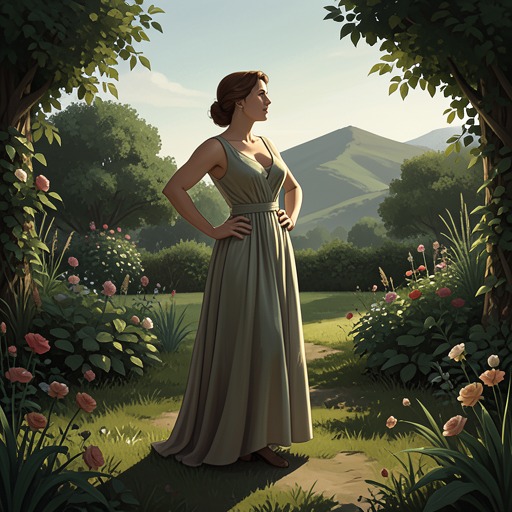
Oliver Mellors
Lady Chatterley's LoverOliver Mellors is the gamekeeper at Wragby whose self-possession and unsettled place in the class system distinguish him from both the estate’s ruling household and the industrial community from which he came. A collier’s son who has served as a blacksmith, soldier, and officer, he is at once rooted in Tevershall and estranged from its social world. His relationship with Connie Chatterley brings that independence into conflict with marriage, public reputation, and the practical work of beginning again.
Identity and Background
Mellors first appears in the wood with a gun and a brown spaniel nearby. His swift, quiet approach startles Connie Chatterley, who initially experiences him as a sudden, threatening presence. Once Clifford Chatterley calls him over, Mellors sets aside his gun and attends to Clifford’s motorized chair. He is lean and moderately tall, economical in manner, and initially avoids looking at Connie. When he does meet her eyes, his direct, impersonal gaze makes her shy; he bows without offering conversation. The formal courtesy sits alongside an air of separateness and self-command.
Clifford explains that Mellors was born in Tevershall to a collier’s family. Before the war, he had already served for two years as gamekeeper at Wragby. He later worked as a blacksmith at the pit, and his experience with horses also shaped his military service. After joining the army in 1915, he worked as a blacksmith to the cavalry in Egypt. A colonel took an interest in him and secured him a commission; Mellors subsequently served in India, became ill, and received a pension. When he returned to Tevershall and sought blacksmith work, Clifford rehired him as gamekeeper, in part because his knowledge of local people made him useful in the post.
His speech makes his shifting social position audible. At their first meeting, Mellors answers Connie in polished English, then lets his Derbyshire dialect emerge as he turns to work. Clifford says he can speak standard English but seems at times to adopt the speech associated with lower ranks. Mellors has moved through military hierarchy and into a gentleman’s role on an estate without belonging comfortably to either. His speech does not resolve that tension; it makes his ability to cross between registers part of his guarded self-presentation.
Work, Reserve, and the Wood
Mellors’s relationship with Connie begins within the ordinary duties of the estate. He turns Clifford’s chair toward the incline in the wood and later makes Connie a key to the keeper’s hut, warning her that he has not been able to make the place tidy. The small act gives her access to a private shelter in the woods. His restraint remains evident: he salutes, offers practical help, and speaks quietly rather than explaining himself at length.
On another visit to the cottage, Connie unexpectedly sees Mellors washing in the enclosed yard. She withdraws without confronting him. The encounter alters how she perceives him: rather than simply the estate employee she might address with an order, he appears to her as a solitary person with a private life. The moment unsettles her and remains with her, though her thoughts also turn toward the awkwardness of having come upon an intimate, everyday scene. The contrast between her response and his unawareness emphasizes the distance between their positions: he is alone in his own space, while she has entered it without intending to.
Mellors’s reserve is not simple indifference. When Connie asks whether he is sad, he answers that he is bored, explaining that he has had to obtain summonses for two poachers he caught and that he dislikes people. He speaks in cold, clear English, with anger in his voice. The episode shows the gamekeeper’s work as a source of contact with the community but not of fellowship: enforcing the rules brings him into dealings with others without making him feel at ease among them.
Connie Chatterley and the Question of a Future
Mellors’s past gives his connection with Connie a history within the local community. Mrs Bolton recognizes him as the man standing near Wragby and understands that he is Connie’s lover. She remembers him as a clever boy who had helped her with her studies when he was sixteen and she was twenty-six. He had won a scholarship to Sheffield Grammar School and learned French, but later became a blacksmith. Her recollection complicates his isolated adult manner: before he was the keeper at Wragby, he was a capable young man whose intelligence and practical help had made a strong impression on her.
Mellors’s marriage has already failed before his relationship with Connie becomes public. Clifford tells Connie that Mellors’s wife left him for other men and eventually went to live with a collier at Stacks Gate. When the possibility of her return arises, Mellors acknowledges that he may have been foolish to return to Wragby, but says he had felt stranded and needed somewhere to go. He dislikes courts, judges, and officials, yet resolves to seek a divorce. Connie sees his decision as a change in direction and responds with inward relief. Later, Mellors tells her that he has consulted a lawyer about the divorce, making clear that the intention has become a practical step rather than a private possibility.
His decision is entangled with a larger question about what he can offer a partner. He describes himself as unable to advance within the existing order, not because he lacks ability, but because he rejects what he sees as the deadening authority of the army, the presumption of money, and the presumption of class. He recalls that soldiers liked him and feared his anger, while higher command seemed to him stupid and lifeless. For a time he had wanted privacy and distance from women; when Connie entered his life, he felt both regret and gladness. He resists treating their relationship as a bargain or imagining himself as merely dependent on her. In his view, a shared life must have direction and meaning, even if that meaning is inward rather than measured by status or financial success.
Public Scandal and Social Conflict
The relationship becomes a public liability after Bertha Coutts, Mellors’s wife, spreads claims about women visiting him at the cottage and names several women. Clifford reports that the accusations have damaged local reputations and that an injunction has been taken out against her. The scandal also makes Mellors’s position at Wragby increasingly difficult. Clifford questions him about his duties in the wood and about Bertha’s trespassing; Mellors says he has not neglected his work and that he cannot prevent her from entering. When Clifford raises the harm caused by the scandal, Mellors answers bitterly that people would be less eager to discuss another man’s affairs if they attended to their own. He also turns the criticism back on Clifford, challenging his standing to judge him.
Mellors’s manner does little to contain the consequences. Clifford considers his replies indecorous and disrespectful, while the rector and other local figures come to think that Mellors should leave. In the village, people warn children away from him as he passes. Clifford perceives that Mellors is affected by the humiliation even though he continues to act as if it has no hold on him. The scandal thus exposes a cost of his defiance: he may reject the judgment of respectable society, but he cannot prevent its judgments from affecting his livelihood and place in the community.
Work Beyond Wragby
In a letter dated 29 September from Grange Farm, Old Heanor, Mellors describes the work he has found after leaving the estate. He obtained the position through Richards, a company engineer he had known in the army. The farm belongs to Butler and Smitham Colliery Company and supplies hay and oats for pit ponies. Mellors earns thirty shillings a week as a laborer, while the farmer, Rowley, tries to give him as many different tasks as possible so that he can learn the work before the following Easter. He has heard nothing from Bertha and does not know why she failed to appear in the divorce proceedings; he hopes that keeping out of trouble until March will allow him to be free.
The farm offers no grand promise of advancement. Mellors says he finds the work acceptable without expecting it to inspire him. He is familiar with horses and finds the cows soothing; milking and the recent oat harvest give him practical routines, though the harvest has left his hands sore and involved a great deal of rain. His lodgings are in an old cottage in Engine Row, where he lives with a couple whose only son was killed in the war and their daughter, who is training to be a schoolteacher. Mellors sometimes helps her with her lessons, and he describes the household as kind to him. The details mark a modest but consequential change: away from Wragby, he is earning his living, learning farm work, and forming everyday ties while waiting for the legal and personal conditions of a new life to be settled.
Mellors’s role in the novel is therefore not only that of Connie’s lover. His movement between estate service, military rank, local labor, and farm work gives the relationship a social dimension: intimacy draws together people separated by class, but it does not erase the constraints imposed by reputation, marriage, or employment. His independence is real but precarious, sustained less by wealth or position than by the work he can do and the choices he is prepared to make.